High-precision commercial electric scooters manufactured under ISO9001 and CE frameworks. Sourced directly from our state-of-the-art manufacturing facilities.
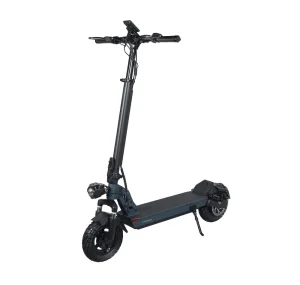
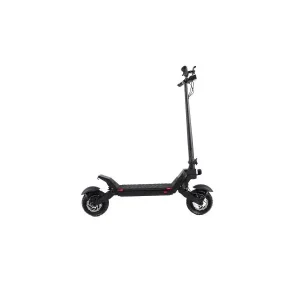
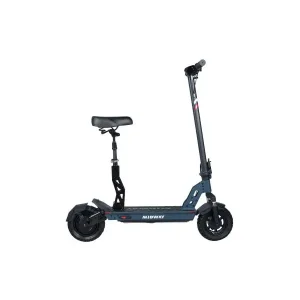
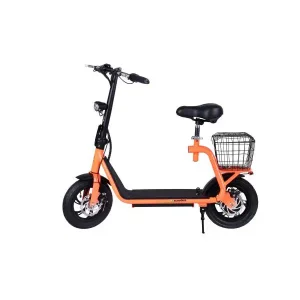
An exhaustive analysis of micro-mobility infrastructure, aging demographic demands, commercial campus logistics, and supply chain manufacturing benchmarks.
The global demand for 4-wheel mobility scooters and electric personal transports has experienced an unprecedented structural shift over the past decade. Driven by a converging matrix of global demographic aging, heightened municipal focus on micro-mobility accessibility, and commercial adoption within large-scale industrial complexes, the global market size for 4-wheel electric scooters is projected to expand at a CAGR exceeding 8.4% through 2030. For international B2B buyers, distributors, medical device importers, and mobility brand owners, navigating the ecosystem of Wholesale 4 Wheel Scooter Suppliers & Factories requires a rigorous understanding of engineering specifications, regional regulatory landscapes, and factory audit frameworks.
Historically, the market was divided into high-cost domestic Western assembly operations and basic overseas OEMs. Today, top-tier Chinese manufacturing centers—particularly in industrial hubs like Zhejiang—have transitioned into advanced technology integrators. By consolidating raw material supply chains, robotics-assisted chassis welding, automated motor winding, and strict quality control, premier Chinese OEM/ODM factories offer unprecedented price-to-performance ratios without compromising structural integrity or rider safety.
By 2050, the global population over 60 years old will reach 2.1 billion. Demand for heavy-duty, long-range 4-wheel mobility scooters is expanding beyond medical channels into lifestyle and community micro-mobility.
Large-scale industrial parks, resorts, airports, and golf communities are standardizing 4-wheel low-speed vehicles (LSVs) for internal workforce transit and guest mobility logistics.
Transition from legacy sealed lead-acid (SLA) batteries to advanced LiFePO4 (LFP) chemistry with CAN-bus integrated Battery Management Systems (BMS) for enhanced lifespan and fast charging.
Understanding the core hardware components that define durability, load capacity, and operational safety in commercial 4-wheel electric vehicles.
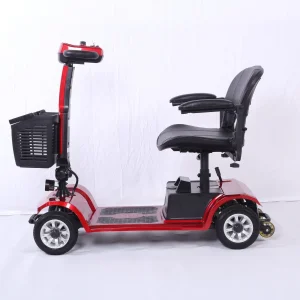
The structural backbone of any 4-wheel scooter relies on high-tensile robotic-welded steel tubing. Premium manufacturers utilize cold-drawn carbon steel chassis with electro-coated anti-corrosion finishes. Quad-wheel layout engineering incorporates a low center of gravity (CoG), optimized track width, and double A-arm independent front suspension to prevent tip-over risks during sharp turning radii at elevated speeds (up to 15-25 km/h).
Modern 4-wheel scooters utilize sealed electromagnetic motor transaxles ranging from 250W continuous output for elderly indoor mobility up to 1200W-1500W heavy-duty brushless motors for off-road all-terrain applications. Integrated automatic electromagnetic braking systems (EMB) ensure immediate holding power on 15–20 degree inclines, preventing roll-back and providing complete operator safety.
A detailed operational guide for B2B buyers auditing manufacturing capabilities, managing tooling investments, and establishing supply chain resilience.
When evaluating Wholesale 4 Wheel Scooter Suppliers & Factories, corporate purchasing managers must look beyond superficial pricing and evaluate true Total Cost of Ownership (TCO), supplier manufacturing maturity, and engineering flexibility. Customization requirements typically span three core tiers:
Standard factory platform branding. Includes customized paint colors, decal branding, user manuals, and regional charger plug adaptations. Quickest time-to-market with minimal MOQ thresholds (typically 20ft container loads).
Tailoring battery chemistry (LFP vs. NMC vs. Lead-Acid), upgrading motor transaxle outputs, modifying controller algorithms (PG Drives / Curtis controllers), and adding specialized seat configurations or heavy-duty cargo baskets.
Bespoke fairing plastic injection mold design, frame geometry modification for specialized commercial applications (e.g., medical transport, heavy-payload airport fleets), and custom IoT telematics hardware integration.
Navigating stringent regional regulations across North America, the European Union, Australia, and emerging markets.
For European distribution, mobility scooters categorized as medical devices must comply with Regulation (EU) 2017/745 (MDR) and EN 12184 (Electrically powered wheelchairs, scooters, and their chargers). Non-medical consumer micro-mobility 4-wheelers must satisfy Machine Directive 2006/42/EC, CE low voltage directives, and UN38.3 battery transport standards.
In the United States, medical 4-wheel mobility scooters are Class II Medical Devices requiring 510(k) clearance or 510(k) exemption registration with the FDA. Commercial lithium-powered units must obtain UL 2272 (Electrical Systems for Personal E-Mobility Devices) and UL 2271 (Batteries) to mitigate fire liability risks for retail and fleet operations.
Emerging innovations redefining user safety, intelligent telematics, and operational efficiency across global markets.
Integration of 4G LTE/5G telematics modules directly into scooter controllers. Allows fleet operators to monitor real-time battery State-of-Health (SoH), geofence operational zones, execute remote firmware updates (OTA), and automate diagnostics.
Implementation of ultrasonic proximity sensors and millimeter-wave radar modules to automatically decelerate the scooter when approaching obstacles or pedestrians, significantly lowering insurance liability for commercial rental operators.
Transition from standard lithium-ion to semi-solid state batteries offering 40% higher energy density, eliminating thermal runaway risk, and enabling 0-80% rapid charging within 30 minutes for uninterrupted multi-shift enterprise use.
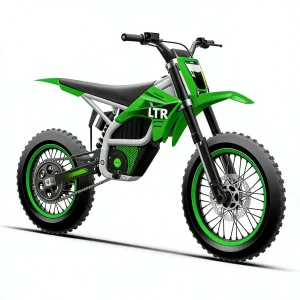
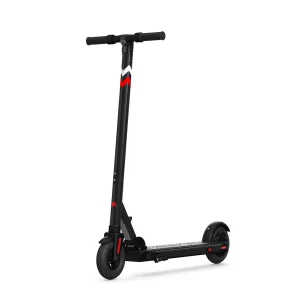
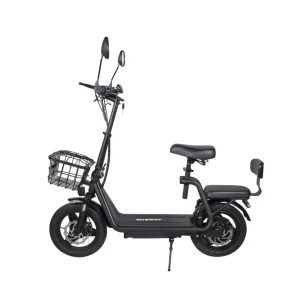
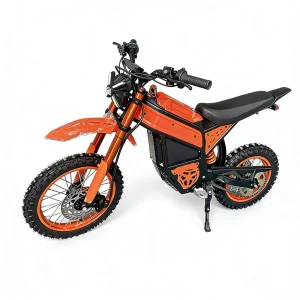
High-power, extended-range, and terrain-adaptable models direct from our certified factory manufacturing lines.
Detailed answers regarding production lead times, minimum order quantities (MOQ), OEM customizations, battery compliance, and warranty policies.